From NASA.gov:
Shuttle astronauts will make one final house call to NASA's Hubble Space Telescope as part of a mission to extend and improve the observatory's capabilities through 2013.
NASA Administrator Michael Griffin announced plans for a fifth servicing mission to Hubble Tuesday during a meeting with agency employees at NASA's Goddard Space Flight Center, Greenbelt, Md. Goddard is the agency center responsible for managing Hubble.
"We have conducted a detailed analysis of the performance and procedures necessary to carry out a successful Hubble repair mission over the course of the last three shuttle missions. What we have learned has convinced us that we are able to conduct a safe and effective servicing mission to Hubble,"
Griffin said. "While there is an inherent risk in all spaceflight activities, the desire to preserve a truly international asset like the Hubble Space Telescope makes doing this mission the right course of action."
The flight is tentatively targeted for launch during the spring to fall of 2008. Mission planners are working to determine the best location and vehicle in the manifest to support the needs of Hubble while minimizing impact to International Space Station assembly. The planners are investigating the best way to support a launch on need mission for the Hubble flight. The present option will keep Launch Pad 39-B at the Kennedy Space Center, Fla., available for such a rescue flight should it be necessary.
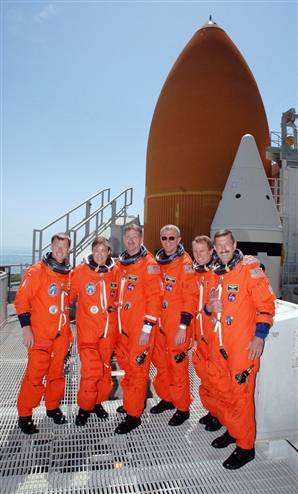
Griffin also announced the astronauts selected for the mission. Veteran astronaut Scott D. Altman will command the final space shuttle mission to Hubble. Navy Reserve Capt. Gregory C. Johnson will serve as pilot. Mission specialists include veteran spacewalkers John M. Grunsfeld and Michael J.
Massimino and first-time space fliers Andrew J. Feustel, Michael T. Good and K. Megan McArthur.
Altman, a native of Pekin, Ill., will be making his fourth spaceflight and his second trip to Hubble. He commanded the STS-109 Hubble servicing mission in 2002. He served as pilot of STS-90 in 1998 and STS-106 in 2000. Johnson, a Seattle native and former Navy test pilot and NASA research pilot, was selected as an astronaut in 1998. He will be making his first spaceflight.
Chicago native Grunsfeld, an astronomer, will be making his third trip to Hubble and his fifth spaceflight. He performed five spacewalks to service the telescope on STS-103 in 1999 and STS-109 in 2002. He also flew on STS-67 in 1995 and STS-81 in 1997. Massimino, from Franklin Square, N.Y., will be making his second trip to Hubble and his second spaceflight. He performed two spacewalks to service the telescope during the STS-109 mission in 2002.
Feustel, Good and McArthur were each selected as astronauts in 2000.
Feustel, a native of Lake Orion, Mich., was an exploration geophysicist in the petroleum industry at the time of his selection by NASA. Good is from Broadview Heights, Ohio, and is an Air Force colonel and weapons' systems officer. He graduated from the Air Force Test Pilot School, having logged more than 2,100 hours in 30 different types of aircraft. McArthur, born in Honolulu, considers California her home state. An oceanographer and former chief scientist at the Scripps Institution of Oceanography, she has a doctorate from the University of California-San Diego.
The two new Hubble instruments are the Cosmic Origins Spectrograph (COS) and Wide Field Camera 3 (WFC3). The COS is the most sensitive ultraviolet spectrograph ever flown on Hubble. The instrument will probe the cosmic web, the large-scale structure of the universe whose form is determined by the gravity of dark matter and is traced by the spatial distribution of galaxies and intergalactic gas.
WFC3 is a new camera sensitive across a wide range of wavelengths (colors), including infrared, visible and ultraviolet light. It will have a broad inquiry from the planets in our solar system to the early and distant galaxies beyond Hubble's current reach, to nearby galaxies with stories to tell about their star formation histories.
Other planned work includes installing a refurbished Fine Guidance Sensor that replaces one degrading unit of the three already onboard. The sensors control the telescope's pointing system. An attempt will also be made to repair the Space Telescope Imaging Spectrograph. Installed in 1997, it stopped working in 2004. The instrument is used for high resolution studies in visible and ultraviolet light of both nearby star systems and distant galaxies, providing information about the motions and chemical makeup of stars, planetary atmospheres and other galaxies.
"Hubble has been rewriting astronomy text books for more than 15 years, and all of us are looking forward to the new chapters that will be added with future discoveries and insights about our universe," said Mary Cleave, NASA's associate administrator for the Science Mission Directorate.
The Hubble servicing mission is an 11-day flight. Following launch, the shuttle will rendezvous with the telescope on the third day of the flight.
Using the shuttle's mechanical arm, the telescope will be placed on a work platform in the cargo bay. Five separate spacewalks will be needed to accomplish all of the mission objectives.
"The Hubble mission will be an exciting mission for the shuttle team. The teams have used the experiences gained from Return to Flight and station assembly to craft a very workable Hubble servicing flight. The inspection and repair techniques, along with spacewalk planning from station assembly, were invaluable in showing this mission is feasible," said Associate Administrator for Space Operations Bill Gerstenmaier. "There are plenty of challenges ahead as the teams do the detailed planning and figure the best way to provide for a launch on need capability for the mission. There is no question that this highly motivated and dedicated flight control team will meet the challenge."
The Hubble Space Telescope is an international cooperative project between NASA and the European Space Agency.
For more information about the mission and the Hubble, visit:
http://www.nasa.gov/hubble
Tuesday, October 31, 2006


Monday, October 16, 2006
NASA May Delay Some Shuttle Launches
By MIKE SCHNEIDER Associated Press Writer
CAPE CANAVERAL, Fla. (AP) -- NASA will likely delay by as much as a month some space shuttle launches scheduled for next year because of a backlog in processing the shuttles' external fuel tanks, an agency spokesman said Monday.
If approved, the revised schedule would push back the first launch of 2007 to March 16 from Feb. 22; the launch of space shuttle Endeavour to June 28 from June 11; and the launch of Atlantis to Sept. 7 from Aug. 9. Two other flights carrying international space station parts constructed by the European and Japanese space agencies still are scheduled for later in 2007.
In the three years since the Columbia disaster, NASA's efforts to get the external fuel tanks ready for launch have been confounded by design changes and Hurricane Katrina, which damaged the tank assembly plant in New Orleans last year.
"The effects of Katrina are still being felt somewhat," NASA spokesman Kyle Herring said. "Getting back on track with the tank is obviously the biggest challenge there."
NASA is still putting a new fuel tank design through wind-tunnel tests, but the initial results have been promising. Engineers hope the new design reduces the amount of insulating foam that drops off during liftoff from wedge-shaped brackets on the tank that hold pressurization lines in place. The first tank with the design change could be used during Atlantis' flight next March.
Foam that fell from space shuttle Columbia's fuel tank caused a gash in a wing in 2003, causing the spacecraft to disintegrate during re-entry and killing seven astronauts.
The next launch this year - the first at night in four years - is set for no earlier than Dec. 7. Space shuttle Discovery will deliver a crew member to the space station and allow astronauts to hook up power to solar wings that were installed on the space station last month.
© 2006 The Associated Press. All rights reserved. This material may not be published, broadcast, rewritten or redistributed. Learn more about our Privacy Policy.
CAPE CANAVERAL, Fla. (AP) -- NASA will likely delay by as much as a month some space shuttle launches scheduled for next year because of a backlog in processing the shuttles' external fuel tanks, an agency spokesman said Monday.
If approved, the revised schedule would push back the first launch of 2007 to March 16 from Feb. 22; the launch of space shuttle Endeavour to June 28 from June 11; and the launch of Atlantis to Sept. 7 from Aug. 9. Two other flights carrying international space station parts constructed by the European and Japanese space agencies still are scheduled for later in 2007.
In the three years since the Columbia disaster, NASA's efforts to get the external fuel tanks ready for launch have been confounded by design changes and Hurricane Katrina, which damaged the tank assembly plant in New Orleans last year.
"The effects of Katrina are still being felt somewhat," NASA spokesman Kyle Herring said. "Getting back on track with the tank is obviously the biggest challenge there."
NASA is still putting a new fuel tank design through wind-tunnel tests, but the initial results have been promising. Engineers hope the new design reduces the amount of insulating foam that drops off during liftoff from wedge-shaped brackets on the tank that hold pressurization lines in place. The first tank with the design change could be used during Atlantis' flight next March.
Foam that fell from space shuttle Columbia's fuel tank caused a gash in a wing in 2003, causing the spacecraft to disintegrate during re-entry and killing seven astronauts.
The next launch this year - the first at night in four years - is set for no earlier than Dec. 7. Space shuttle Discovery will deliver a crew member to the space station and allow astronauts to hook up power to solar wings that were installed on the space station last month.
© 2006 The Associated Press. All rights reserved. This material may not be published, broadcast, rewritten or redistributed. Learn more about our Privacy Policy.
Monday, September 25, 2006
DELTA II LAUNCHES SUCCESFULLY!
A Boeing Delta II launch vehicle succesfull launched a military payload into space this afternoon.
Launch time 2:50 EDT.
Launch time 2:50 EDT.
Thursday, September 21, 2006
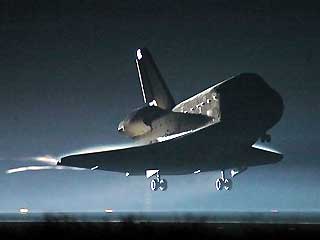
Thursday, September 14, 2006
Astronauts Unfurl Space-Station Solar Panel

NASA unfurled the first of two golden solar wings on the new 17½-ton addition to the international space station early Thursday after overcoming a software problem that delayed the maneuver for hours.
The solar panel, slowly opening like an accordion window blind, looked like a cosmic blanket of gold bars in the reflection of an orbital sunrise.
The astronauts adjusted the space station's position so the panel would be heated by the sun to prevent it from sticking together, a problem astronauts have encountered before.
• Click here to visit FOXNews.com's Space Center.
NASA engineers ran into an early problem when they didn't get the response they wanted from commands to a ferris-wheel-like rotating joint that allows the solar arrays to move with the sun to maximize the amount of power generated.
They were able to fix the software glitch, but it put the day's activities several hours behind schedule.
Space shuttle Atlantis' 11-day schedule is tightly packed, and the arrays need to be deployed in order for astronauts to go on the third and final spacewalk of the mission Friday.
The mission is the first since late 2002 to resume space station construction, which was halted after the Columbia accident in early 2003.
"About the only thing on the timeline that's accurate at this point is probably the postsleep," astronaut Kevin Ford in Mission Control in Houston told space station astronaut Jeff Williams, referring to the time after the crew wakes up devoted to personal hygiene.
"Nothing like adding a little drama to the day," Williams said a short time later.
The solar arrays were mounted on blankets and folded up like an accordion for delivery to space as part of the new $372 million addition added to the space station. Together, they span 240 feet.
When the space station is completed in 2010, the solar arrays will provide about a quarter of its power.
Two of Atlantis' astronauts are experienced in deploying solar arrays. Atlantis commander Brent Jett and mission specialist Joe Tanner were members of a crew in 2000 that also delivered a pair of solar wings to the space station.
During that mission, the solar panels unexpectedly stuck to each other while they were being deployed, but the problem was fixed.
This time around, NASA devised a new method for unfurling the solar wings which allowed them to be heated up by the sun.
Friday, September 08, 2006
Failed Sensor Delays Shuttle Launching
Today’s scheduled launching of the space shuttle Atlantis was scrubbed with less than an hour left in the countdown because of a faulty sensor in the huge external fuel tank.
NASA will drain the liquid hydrogen and oxygen from the tank and try to fix the problem in time for a launching at 11:15 a.m. Saturday, agency officials said.
The fuel sensor problem is the latest glitch to plague an Atlantis flight that had already been delayed by a lightning strike, Tropical Storm Ernesto and a problem with a power-generating fuel cell.
Though the six astronauts had already boarded the shuttle, the problem with the sensor in the hydrogen sector of the tank meant the spacecraft did not meet NASA’s safety criteria for a launch. The cancellation was “the right thing to do,” a NASA official said.
The weather on Saturday is expected to be as good as it is today, agency officials told the astronauts, which means the launching will be possible if the technical problem can be fixed.
If it cannot go on Saturday, Atlantis will have to be wait at least two weeks, agency officials said, to avoid interference with a Russian Soyuz mission to the Space Station scheduled to lift off on Sept 18.
The sensor in the hydrogen fuel tank is designed to ensure that the spacecraft’s main engines run for the correct amount of time after liftoff. There are three other sensors in the tank, and NASA could have decided to fly with one malfunctioning, but instead chose to adhere strictly to its safety standards.
Today’s cancellation came after space agency officials said Thursday that a problem in an electrical generator presented a “minimum risk.”
The National Aeronautics and Space Administration postponed a launching attempt on Wednesday because of an erratic reading from a pump that chills one of the shuttle’s three fuel cells, which generate electricity. After a detailed study of the readings, engineers determined that the fuel cell was “probably acceptable to fly with” and should not curtail the mission, said N. Wayne Hale Jr., shuttle program director.
A majority of the managers polled at a Thursday afternoon meeting voted to try for this morning, Mr. Hale said, with the only objections based on issues other than safety. The Office of Safety and Mission Assurance at the agency voted for replacing the pump and flying later to ensure that the goals of the mission were achieved, not because of safety concerns, he said.
Mr. Hale said the agency was not bowing to schedule pressure and a closing launching window in pressing ahead. Safety was the primary concern, he said.
“We have stood down two days to make sure we are safe to fly,” he said at an evening news conference at the Kennedy Space Center here. “We have gone the extra mile.”
Atlantis was scheduled to take off on an 11-day mission to resume construction on the International Space Station.
Michael Suffredini, NASA’s space station program manager, said he had spoken with the Russians about avoiding a conflict in the flights. If the Atlantis lifted off on Saturday, it would need to undock from the station on the day of the Soyuz launching instead of the day before, as had been planned.
Mr. Hale said launching at the end of the window would not require the Atlantis to cut its mission short or curtail any of its planned tasks.
The space agency is eager to resume station construction, which has been suspended for almost four years because of the 2003 Columbia accident, which grounded the shuttle fleet. The Atlantis is carrying a $372 million, 30,000-pound, bus-size segment of the station’s backbone that includes a new set of solar power arrays.
On the busy mission, the shuttle’s crew is supposed to conduct three complicated spacewalks to attach the segment and deploy the solar arrays. The next half-dozen shuttle missions to the station are intended to complete a structure that will hold the station’s four main power arrays and a complex wiring and plumbing system.
The agency plans to undertake 16 shuttle missions to complete the assembly of the half-finished space station by 2010, when the three-shuttle fleet is set to retire.
While only one fuel cell is required for a shuttle to operate, NASA rules call for all three units to be working for the shuttle to take off. If one of the units fails in flight, the rules call for ending the mission and returning home early.
Replacing the fuel cell could have delayed any launching attempt by several weeks.
Steve Poulos, manager of shuttle orbiter projects, said that the unit was working and that replacing it would increase the chance of creating new problems. The unit is safe to use, he said.
“Our risk really is going to be minimal,” Mr. Poulos said.
Fuel cell problems have affected several shuttle missions. In 1995, the launching of the Endeavour was delayed eight days so workers could remove and replace a bad fuel cell. A 1997 flight of the Columbia returned to Earth four days after launching when a cell failed. That cell showed erratic readings before taking off, but the Columbia was cleared to fly.
NASA will drain the liquid hydrogen and oxygen from the tank and try to fix the problem in time for a launching at 11:15 a.m. Saturday, agency officials said.
The fuel sensor problem is the latest glitch to plague an Atlantis flight that had already been delayed by a lightning strike, Tropical Storm Ernesto and a problem with a power-generating fuel cell.
Though the six astronauts had already boarded the shuttle, the problem with the sensor in the hydrogen sector of the tank meant the spacecraft did not meet NASA’s safety criteria for a launch. The cancellation was “the right thing to do,” a NASA official said.
The weather on Saturday is expected to be as good as it is today, agency officials told the astronauts, which means the launching will be possible if the technical problem can be fixed.
If it cannot go on Saturday, Atlantis will have to be wait at least two weeks, agency officials said, to avoid interference with a Russian Soyuz mission to the Space Station scheduled to lift off on Sept 18.
The sensor in the hydrogen fuel tank is designed to ensure that the spacecraft’s main engines run for the correct amount of time after liftoff. There are three other sensors in the tank, and NASA could have decided to fly with one malfunctioning, but instead chose to adhere strictly to its safety standards.
Today’s cancellation came after space agency officials said Thursday that a problem in an electrical generator presented a “minimum risk.”
The National Aeronautics and Space Administration postponed a launching attempt on Wednesday because of an erratic reading from a pump that chills one of the shuttle’s three fuel cells, which generate electricity. After a detailed study of the readings, engineers determined that the fuel cell was “probably acceptable to fly with” and should not curtail the mission, said N. Wayne Hale Jr., shuttle program director.
A majority of the managers polled at a Thursday afternoon meeting voted to try for this morning, Mr. Hale said, with the only objections based on issues other than safety. The Office of Safety and Mission Assurance at the agency voted for replacing the pump and flying later to ensure that the goals of the mission were achieved, not because of safety concerns, he said.
Mr. Hale said the agency was not bowing to schedule pressure and a closing launching window in pressing ahead. Safety was the primary concern, he said.
“We have stood down two days to make sure we are safe to fly,” he said at an evening news conference at the Kennedy Space Center here. “We have gone the extra mile.”
Atlantis was scheduled to take off on an 11-day mission to resume construction on the International Space Station.
Michael Suffredini, NASA’s space station program manager, said he had spoken with the Russians about avoiding a conflict in the flights. If the Atlantis lifted off on Saturday, it would need to undock from the station on the day of the Soyuz launching instead of the day before, as had been planned.
Mr. Hale said launching at the end of the window would not require the Atlantis to cut its mission short or curtail any of its planned tasks.
The space agency is eager to resume station construction, which has been suspended for almost four years because of the 2003 Columbia accident, which grounded the shuttle fleet. The Atlantis is carrying a $372 million, 30,000-pound, bus-size segment of the station’s backbone that includes a new set of solar power arrays.
On the busy mission, the shuttle’s crew is supposed to conduct three complicated spacewalks to attach the segment and deploy the solar arrays. The next half-dozen shuttle missions to the station are intended to complete a structure that will hold the station’s four main power arrays and a complex wiring and plumbing system.
The agency plans to undertake 16 shuttle missions to complete the assembly of the half-finished space station by 2010, when the three-shuttle fleet is set to retire.
While only one fuel cell is required for a shuttle to operate, NASA rules call for all three units to be working for the shuttle to take off. If one of the units fails in flight, the rules call for ending the mission and returning home early.
Replacing the fuel cell could have delayed any launching attempt by several weeks.
Steve Poulos, manager of shuttle orbiter projects, said that the unit was working and that replacing it would increase the chance of creating new problems. The unit is safe to use, he said.
“Our risk really is going to be minimal,” Mr. Poulos said.
Fuel cell problems have affected several shuttle missions. In 1995, the launching of the Endeavour was delayed eight days so workers could remove and replace a bad fuel cell. A 1997 flight of the Columbia returned to Earth four days after launching when a cell failed. That cell showed erratic readings before taking off, but the Columbia was cleared to fly.
Wednesday, September 06, 2006
STS-115 Launch Delayed 24 hours
The launch of STS-115 has been put on hold at least 24 hours, due to an apparent fuel cell short.
Discussions are underway to determine if this issue can be resolved without rolling back the shuttle stack to the Vehicle Assembly Building for repairs.
Developing.....
Discussions are underway to determine if this issue can be resolved without rolling back the shuttle stack to the Vehicle Assembly Building for repairs.
Developing.....
Thursday, August 31, 2006
Tuesday, August 29, 2006
ATLANTIS BACK AT PAD 39B
flatoday.com:
Atlantis: The go-forward planNASA is aiming to launch Atlantis and six astronauts on Sept. 6 aftersending the ship back to its launch pad mid-way through a move towardthe shuttle's 52-story assembly building.The agency will be closing Kennedy Space Center to all but essentialpersonnel until Tropical Storm Ernesto passes over central Florida onWednesday.
A damage assemssment team then will be sent into thespaceport, and NASA hopes to restart launch preparations on Thursday.In that case, technicians would validate mechanical, electrical andother connections between the shuttle and its launch pad.Small explosive devices used to seperate the shuttle from its mobilelauncher platform, twin solid rocket boosters and external tank wouldbe reconnected on Friday. The orbiter's main propulsion system andpropellant tanks that feed its 44 nose-and-tail steering jets would bepressurized that day.
A standard three-day countdown would start Sunday. Liftoff on Sept. 6 would come at 12:29 p.m.
Atlantis: The go-forward planNASA is aiming to launch Atlantis and six astronauts on Sept. 6 aftersending the ship back to its launch pad mid-way through a move towardthe shuttle's 52-story assembly building.The agency will be closing Kennedy Space Center to all but essentialpersonnel until Tropical Storm Ernesto passes over central Florida onWednesday.
A damage assemssment team then will be sent into thespaceport, and NASA hopes to restart launch preparations on Thursday.In that case, technicians would validate mechanical, electrical andother connections between the shuttle and its launch pad.Small explosive devices used to seperate the shuttle from its mobilelauncher platform, twin solid rocket boosters and external tank wouldbe reconnected on Friday. The orbiter's main propulsion system andpropellant tanks that feed its 44 nose-and-tail steering jets would bepressurized that day.
A standard three-day countdown would start Sunday. Liftoff on Sept. 6 would come at 12:29 p.m.
Monday, August 28, 2006
LAUNCH SCRUBBED, ROLLBACK SOON, ERNESTO CREEPING TOWARDS FLORIDA
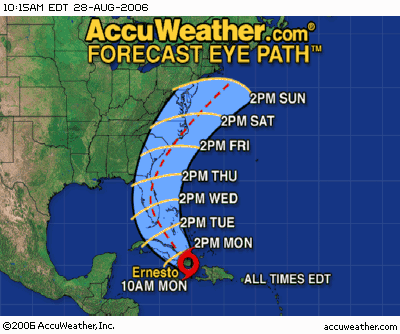
A hurricane watch has been issued for the southern Peninsula of Florida from New Smyrna southward on the east coast, and from south of Chokoloskee southward along the west coast. A hurricane watch remains in effect for all of the Florida Keys from Ocean Reef to the Dry Tortugas. A hurricane watch is also in effect for Anddros Island in the northwestern Bahamas, the Biminis and Grand Bahama Island. Hurricane warning is in effect for the southwestern peninsula of Haiti from the Haiti-Dominican Republic border westward to the southwest tip of Haiti. A tropical storm warning is in effect for the Cuban provinces of Guantanamo, Santiago de Cuba, Ranma, Olguin, Las Tunas and Camaguey and the Ragged Silands and Great Exuma Island in the central Bahamas. A tropical storm watch is in effect for the Cayman Islands
At 11 a.m., EDT, Monday, the center of Tropical Storm Ernesto was located near 20.3 north and 75.7 west. It is over the eastern tip of Cuba, about 35 miles west northwest of Guantanamo, Cuba, with maximum sustained winds of 40 mph. Ernesto was moving to the northwest at near 10 mph. The surface pressure is 1006 millibars or 29.71 inches.
On Sunday, Ernesto became the first hurricane of the 2006 Atlantic Hurricane Season with maximum sustained winds reaching 75 mph. However, after moving over the mountainous terrain of southwestern Haiti, Ernesto weakened to a tropical storm by Sunday afternoon. Ernesto is now over the mountainous terrain of eastern Cuba.
Once Ernesto emerges from Cuba later today, it will begin to turn more to the north as it moves around the edge of an area of high pressure located east of Jacksonville, Fla., in the mid-levels of the atmosphere and also begins to be picked up by an approaching upper-level trough digging into the Mississippi River Valley. This will take Ernesto to or very near South Florida by late Tuesday. Just how much the mid-level ridge of high pressure weakens will determine just how far east or west Ernesto tracks when it gets toward South Florida. Although the best case scenario now still favors a track northward across the Florida Peninsula, there is also the potential for Ernesto to pass just along or just off the east coast of Florida.
Ernesto's intensity at its approach to South Florida is also highly dependent on just how much time it spends over Cuba. The quicker Ernesto can get back into water, the stronger it will likely be when it arrives near South Florida. Ernesto will move over very warm waters as well and will be in an area where the upper-level winds are light and favorable for further development; therefore, it is not unreasonable for Ernesto to become a hurricane by the time it makes a landfall or is near the coast of South Florida.
The fringe effects of Ernesto will be felt in South Florida by early Tuesday with conditions rapidly deteriorating as the day progresses as the outer squalls of Ernesto work northward. Strong winds and heavy bands of rain will be the main threat and even an isolated tornado or waterspout is possible. Rough surf will also pound the coast, especially in the Keys and along the southeast Florida coast, bringing the threats of storm surge and beach erosion.
As time progresses, the effects of Ernesto will work northward into central and northeastern Florida Wednesday and into southeastern Georgia and the low country of South Carolina by Thursday. In time, Ernesto will curve northeast up the East Coast of the United States and it is highly possible that it will be hurricane when it affects these areas as well.
Sunday, August 27, 2006
STS-115 Launch Delayed to at least Tuesday
The STS-115 launch has been delayed to at least Tuesday to continue checking the pad for possible lightning damage.
Developing........
Developing........
Saturday, August 26, 2006
Shuttle Launch Forecast Worsens Slightly
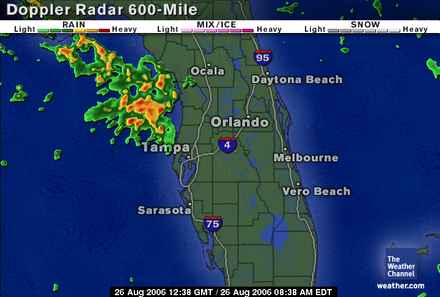
The weather forecast for the launch of space shuttle Atlantis worsened slightly Friday, with storms expected in the area hours before Sunday's launch.
There was a 40 percent chance that weather at the Kennedy Space Center would prohibit a lift off at 4:30 p.m. Sunday, NASA's first launch opportunity, said Kathy Winters, shuttle weather officer.
Area storms likely will push westward before liftoff, Winters said. But NASA won't launch if there are storms within 23 miles of the shuttle landing runway, in case astronauts need to make an emergency landing.
"We're probably go red through the countdown," said Winters, referring to a violation.
Stormy weather and a lightning strike at the launch pad forced technicians Friday to delay fueling the system that will power the space shuttle during the mission. The interruption wasn't expected to affect the countdown since the fueling had started earlier than planned. The lightning struck a wire on a tower used as lightning protection and didn't appear to cause damage, said launch director Mike Leinbach.
"It's not unexpected that we get a lightning strike at the pad this time of the year," Leinbach said.
Forecasters were also watching Tropical Storm Ernesto, although it wasn't expected to affect Sunday's launch. Ernesto was projected to enter the Gulf of Mexico on Tuesday or Wednesday.
If Ernesto struck Houston and caused workers at Mission Control to evacuate, the Atlantis mission likely would be aborted midway, and the shuttle and its astronauts would return to Florida, NASA manager said.
Last September, during Hurricane Rita, Johnson Space Center in Houston was locked down, the power turned off and monitoring duties for the international space station were turned over to Russian flight controllers outside Moscow. There was no space shuttle mission going on at the time. The same thing happened in 2002 when another approaching storm threatened the space center.
During their 11-day mission, Atlantis' six astronauts will restart building the international space station before the cargo-carrying shuttles are retired in 2010. Construction has been delayed since the 2003 Columbia explosion, which killed seven astronauts.
Atlantis will carry a 17 1/2-ton addition for the space station, costing $372 million, from which two solar wings will be opened up. The solar arrays eventually will provide a quarter of the space station's power when it is finished.
NASA wasn't tracking any major technical issues with Atlantis, said Pete Nickolenko, a NASA test director.
"All our systems are in great shape," he said. "The countdown is right on schedule."
Friday, August 25, 2006
Launch Countdown Began for Space Shuttle Atlantis
NASA began the countdown for the launch of Space Shuttle Atlantis on mission STS-115 at noon EDT Thursday, Aug. 24, at the T-43 hour point. During this mission, Atlantis' crew will resume the construction of the International Space Station, which is the goal of the remaining space shuttle flights in the program.
This mission is the 116th space shuttle flight, the 27th flight for orbiter Atlantis, and the 19th U.S. flight to the International Space Station. STS-115 is scheduled to last 11 days with a planned KSC landing at about 12:02 p.m. EDT on Sept. 7.
Atlantis rolled into KSC's Orbiter Processing Facility on Oct. 18, 2002, after returning from its last mission, STS-112. Its next mission was planned to be STS-114; however, during the program delays following the loss of orbiter Columbia, Atlantis was reassigned to mission STS-115. The orbiter rolled out of the facility's bay 1 and into the Vehicle Assembly Building on July 24. While in the building's high bay 3, Atlantis was mated to its modified external tank and solid rocket boosters. The entire space shuttle stack was transferred to Launch Pad 39B on Aug. 2.
The STS-115 crew includes Commander Brent Jett, Pilot Chris Ferguson, and Mission Specialists Joe Tanner, Dan Burbank, Heidemarie Stefanyshyn-Piper and Steve MacLean of the Canadian Space Agency.
This mission is the 116th space shuttle flight, the 27th flight for orbiter Atlantis, and the 19th U.S. flight to the International Space Station. STS-115 is scheduled to last 11 days with a planned KSC landing at about 12:02 p.m. EDT on Sept. 7.
Atlantis rolled into KSC's Orbiter Processing Facility on Oct. 18, 2002, after returning from its last mission, STS-112. Its next mission was planned to be STS-114; however, during the program delays following the loss of orbiter Columbia, Atlantis was reassigned to mission STS-115. The orbiter rolled out of the facility's bay 1 and into the Vehicle Assembly Building on July 24. While in the building's high bay 3, Atlantis was mated to its modified external tank and solid rocket boosters. The entire space shuttle stack was transferred to Launch Pad 39B on Aug. 2.
The STS-115 crew includes Commander Brent Jett, Pilot Chris Ferguson, and Mission Specialists Joe Tanner, Dan Burbank, Heidemarie Stefanyshyn-Piper and Steve MacLean of the Canadian Space Agency.
Wednesday, August 23, 2006
GO NO-GO BEANS - (An InsideKSC.com Exclusive)

The following is an exclusive to Inside KSC.com by Debra Richbourg Wolfard, and may not be distributed to any other sources without the expressed written consent of the InsideKSC.com staff.
_________
GO NO-GO BEANS
A group of Kennedy Space Center-area space enthusiasts developed a plan to handle a tricky bean situation on July 1 after STS-121 failed its first launch attempt due to unwieldy weather.
No, we're not talking about an unexpected visit by former astronaut Alan Bean, although the group would certainly welcome him to an after-launch celebration.
The beans we refer to are NASA Launch Beans, a tradition begun with STS-1 back in 1981 by then-NASA test director Norm Carlson. The story goes, according to thefiringroom.com, that during the endlessly long work hours prior to the first shuttle launch, employees began bringing in covered dish meals to share. Carlson's contribution was a crock pot of beans, accompanied by corn bread, which quickly disappeared after STS-1's launch. His beans-and-corn bread became a part of each successful launch.
Hearing about the bean-and-cornbread tradition, we decided to make it part of our post-launch celebration, and I volunteered to research and develop the bean project. Actually, I thought it would be relatively simple, since I'm a fairly experienced cook. But just like many other space related projects, there were unexpected pitfalls along the way.
First, we needed the authentic recipe.
One member of the group emailed me a recipe she had found online, which proclaimed itself to be "Norm Carlson's Space Beans Recipe." No problem, I thought. But wait--the recipe was cryptic (what the heck was 1/2 shaker of lemon pepper?), and the measurement quantities given (six pounds of dried beans, ten pounds of ham) were more appropriate to serving masses at NASA than our group of expected guests. I compared it to other bean recipes in my cooking bible, The Joy of Cooking, only to find I'd have to translate the measurement quantities from pounds to cups in order to arrive at a dimensionally appropriate amount.
I had some math to do. This bunch of space geeks expects authenticity. Determining that the ratio of dry beans to person was approximately x:1, divided by the capacity of my crock pot (six quarts) and, dividing the recipe by 1/3, eventually I arrived at what I thought was a reasonable approximation. Okay, I guessed. I was now feeling extremely sympathetic to those engineers responsible for the doomed Mars Climate Orbiter back in 1999, who were derided for not translating metric measurements used at one facility to English measurements used at another. (Weren't we all supposed to go metric back in the '70s anyway?)
After all that, it was simple to assemble the ingredients and determine when to start the pot cooking so it would be ready for the after-launch gathering. However, delivering a full hot crock pot of beans to its destination, including transferring it from my trusty personal crawler-transporter to a van rented for the launch took some unusual methods not likely food-industry standard.
Finally we had everything in place and headed out to NASA Causeway on Kennedy Space Center, where thanks to one KSC employee in the group, we were to watch the STS-121 launch.
Unfortunately, as we all know, the launch that day was scrubbed due to insistent anvil clouds.
Disappointed but hopeful for launch the next day, we were now faced with a real dilemma. The group consensus was that it would jinx the next launch attempt to eat the beans when there was a scrub, yet it would have seemed half-hearted to have formed a backup plan, as if we really didn't expect it to happen. So there we were with a bunch of hungry people and a large pot of beans that we couldn't eat.
Discussion ensued, along with drinks, and a plan was proposed. If we altered the beans in the pot by adding additional ingredients, then they were no longer authentic launch beans, and we could safely consume them without bringing down bad luck.
Our host raided the pantry, produced three cans of different beans, added them to the mix and promptly dubbed them "Scrub Beans." The beans, at least were "go".
As we know, the launch was called off the following day due to heavy rain, and the third day was a stand-down for crew rest. But Discovery went on to a beautiful launch on the fourth day, the first ever on our nation's Independence Day, so we think our plan worked.
If you're planning a post-launch celebration, including beans, for the upcoming Atlantis mission, here's the original recipe, and the simplified version we came up with, which should feed about twelve people:
Norm Carlson's Space Beans Recipe (The original, we think)
6 pounds Great Northern dried beans
10 pounds ham cut into cubes, plus ham bones
3 pounds chopped onions
2 stalks celery
1/2 shaker lemon pepper
1 teaspoon Liquid Smoke
Cover with water in an 18-quart electric cooker and cook 8-12 hours.
Go-No-Go Beans (Our version)
2 pounds (approximately 2 cups) dried Great Northern Beans
2-3 pounds ham, cubed, with bone
1 pound chopped onion (about one large onion)
1 stalk celery (a stalk, not a rib)
1 tablespoon lemon pepper, or to taste
Dash of Liquid Smoke
Cover all ingredients with water in a large crock pot (about 6-8 quart) and cook for 8-12 hours.
**If the launch is scrubbed, add a couple of cans of kidney, garbanzo, or black beans to the mix to make Scrub Beans**
Enjoy the launch, enjoy the beans (we think they may help fuel the rockets) and don't forget the corn bread.
Go Atlantis!
--by Debra Richbourg Wolfard
NASA Names New Crew Exploration Vehicle Orion
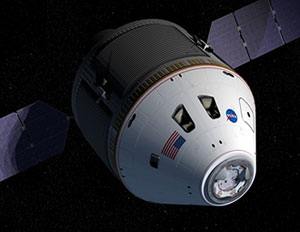
NASA announced Tuesday that its new crew exploration vehicle will be named Orion. Orion is the vehicle NASA’s Constellation Program is developing to carry a new generation of explorers back to the moon and later to Mars. Orion will succeed the space shuttle as NASA's primary vehicle for human space exploration.
Orion's first flight with astronauts onboard is planned for no later than 2014 to the International Space Station. Its first flight to the moon is planned for no later than 2020.
Orion is named for one of the brightest, most familiar and easily identifiable constellations. "Many of its stars have been used for navigation and guided explorers to new worlds for centuries," said Orion Project Manager Skip Hatfield. "Our team, and all of NASA - and, I believe, our country - grows more excited with every step forward this program takes. The future for space exploration is coming quickly." In June, NASA announced the launch vehicles under development by the Constellation Program have been named Ares, a synonym for Mars. The booster that will launch Orion will be called Ares I, and a larger heavy-lift launch vehicle will be known as Ares V. Orion will be capable of transporting cargo and up to six crew members to and from the International Space Station. It can carry four crewmembers for lunar missions. Later, it can support crew transfers for Mars missions. Orion borrows its shape from space capsules of the past, but takes advantage of the latest technology in computers, electronics, life support, propulsion and heat protection systems. The capsule's conical shape is the safest and most reliable for re-entering the Earth’s atmosphere, especially at the velocities required for a direct return from the moon. Orion will be 16.5 feet in diameter and have a mass of about 25 tons. Inside, it will have more than 2.5 times the volume of an Apollo capsule. The spacecraft will return humans to the moon to stay for long periods as a testing ground for the longer journey to Mars.
After 4 1/2 years of waiting, crew looks forward to liftoff Sunday
(AP) Atlantis' six astronauts were supposed to fly to the international space station more than three years ago.
But the Columbia disaster in early 2003 and problems with the shuttle fuel tank kept the spacecraft fleet grounded.
Through it all, the six astronauts have stuck together, and their 4 1/2 years of training has set a record. Now they're looking forward to an Aug. 27 liftoff.
"After Columbia, I wondered if the shuttle was going to fly...I was concerned that we might not get to do this," said Chris Ferguson, Atlantis' pilot, who will make his first trip to space.
The long training period together has created a tight-knit group, said Brent Jett, Atlantis' commander.
"You're with a group for an extended period of time, you've become really like family," Jett said. "Just like any family, we have our own inside jokes."
Of the Atlantic six, two rookies making their first flight in space; three astronauts will make their first-ever spacewalks. Five of the six astronauts are parents, and among them they have 11 children.
Not all of the astronauts are American: Mission specialist Steve MacLean is from the Canadian Space Agency and will be the first Canadian to operate the space station's Canadian-built robotic arm.
U.S. Navy Capt. Brent Jett, commanderAge: 47Hometown: Born in Pontiac, Mich., but considers Fort Lauderdale, Fla., his hometownFamily: Married
Jett will be making his fourth space trip and he already has experience doing some of the tasks required on this mission: delivering an addition to the space station and deploying solar wings to help power the space lab. Along with Atlantis mission specialist Joe Tanner, he was part of a 2000 mission that performed very similar work.
He was selected to join the astronaut corps in 1992. His first spaceflight was a nine-day trip to retrieve a Japanese satellite in 1996. He also visited Russia's Mir space station in 1997, and that was followed by the 2000 construction mission at the space station.
Jett graduated first in his class from the U.S. Naval Academy in 1981 with a degree in aerospace engineering and later earned a master's in aeronautical engineering from the U.S. Naval Postgraduate School. During nine years as a naval aviator, he attended the Naval Fighter Weapons School, graduated from the U.S. Naval Test Pilot School and has served overseas, including aboard the USS Saratoga in the Indian Ocean.
He expects his greatest thrill on this mission will be seeing the reactions of rookie crew mates, Chris Ferguson and Heide Piper.
"I'll be excited just to see them get into space and see their faces on Flight Day 1," Jett said.
U.S. Navy Capt. Chris Ferguson, pilotAge: 44. He will celebrate a birthday during the mission on Sept 1.Hometown: PhiladelphiaFamily: Married, three children
As a drummer for Max Q, an astronaut garage band, Ferguson wanted to bring his drum sticks with him for his first trip to space.
Astronauts can bring a few personal items with them on the shuttle, and Ferguson was down to the last item allowed: "I said I wanted to bring a pair of drum sticks. They said, 'I'm sorry. A pair is two things.'"
Along with mission specialist Dan Burbank, Ferguson will use the shuttle's robotic arm to lift the 35,000-pound addition to the space station. He also will be at the controls when Atlantis undocks for a return trip home.
Ferguson earned a mechanical engineering degree at Drexel University in 1984 and later got a master's in aeronautical engineering from the Naval Postgraduate School. He spent almost 14 years as a Navy pilot and instructor before he was selected to join the astronaut corps in 1998.
He is happy to be part of a mission that is putting the space station back on the path to completion.
"The shuttle is back doing what it's designed to do and that is to deliver heavy payloads to space," he said.
Mission specialist Joe TannerAge: 56Hometown: Danville, Ill.Family: Married, two children
One of Tanner's Atlantis crew mates has described him as the "king" of spacewalks.
Although he doesn't hold the NASA record — that title belongs to astronaut Jerry Ross with nine — by the time Tanner is done with this mission, he will have seven spacewalks under his belt.
Tanner joined the Navy shortly after graduating from the University of Illinois with a degree in mechanical engineering in 1973. He earned his pilot wings two years later and joined NASA as an aerospace engineer and research pilot in 1984, teaching astronaut pilots landing techniques. He was selected to be an astronaut in 1992.
His first mission was a trip filled with science experiments aboard Atlantis in 1994. He walked in space twice to fix the Hubble Space Telescope in 1997. Along with Jett, he was part of the Endeavour crew that delivered a major piece of the international space station and deployed the first solar arrays to power the space lab. He performed three spacewalks during that mission.
"Having done some of these things really helps me," Tanner said. "There's a level of comfort that wouldn't be there if I hadn't done this task before."
U.S. Coast Guard Cmdr. Dan Burbank, mission specialistAge:45Hometown: Born in Manchester, Conn., but considers Tolland, Conn., to be his hometownFamily: Married, two children
Burbank was climbing down a ladder from a shuttle simulator last year when he slipped and tore a bicep tendon while trying to support his weight on his arm. Luckily for him, his trip to space was delayed. So he had plenty of time to recover from what could have been a mission-ending injury.
Burbank earned a degree in electrical engineering from the U.S. Coast Guard Academy in 1985 and a master's degree in aeronautical science from Embry-Riddle Aeronautical University in 1990. He received his Coast Guard commission in 1985, became a pilot three years later and held various assignments with the Coast Guard until he was selected to be an astronaut in 1996.
He was a mission specialist aboard Atlantis in 2000 for a flight that prepared the space station for its first full-time inhabitants. He will perform his first spacewalk during the upcoming mission.
"As we go out for the spacewalk for the first time, I think there will be a little bit of butterflies," Burbank said. "The first thing I'm going to do is go slow and ease my way into it."
U.S. Navy Cmdr. Heidemarie Stefanyshyn-Piper, mission specialistAge: 43Hometown: St. Paul, Minn.Family: Married, one child
Piper, who will make two spacewalking trips outside of the space station, is joining an elite club of only six other U.S. women and a single Russian woman who have made spacewalks.
A big reason so few female astronauts perform spacewalks is because the spacesuit requires a certain stature, said Piper, who is 5-feet-10.
"Height is a big part of it," she said. "If you fit in a suit, then the easier it is to work and that's sometimes a make or break on who gets assigned."
Piper graduated with a bachelor's degree and a master's degree in mechanical engineering from MIT. She received her commission from MIT's Navy ROTC program in 1985 and became a diving and salvage officer. She became an astronaut in 1996 and has waited a decade for her first trip to space.
Piper thinks her background as a Navy diver has helped her train for her two spacewalks.
"I have a good idea in my mind how difficult it is to do things when you're not standing on the ground ... how you have to think differently when you're kind of floating," she said.
Mission specialist Steve MacLean of the Canadian Space AgencyAge: 51Hometown: OttawaFamily: Married, three children
Thirty years ago MacLean was on the Canadian National Gymnastics team trying to make the Olympics, an experience that served him well as an astronaut about to perform his first spacewalk.
"It's similar in the sense of the discipline that's required, the attention to details that's required to be an athlete or a spacewalking astronaut," he said.
MacLean earned a bachelor's degree and a doctorate in physics from York University in Toronto. He was a visiting scholar at Stanford University, studying laser physics under the Nobel laureate A.L. Schawlow.
He was picked as one of the first six Canadian astronauts in 1983 and flew on his first shuttle mission aboard Columbia in 1992. He was chief science adviser for the international space station and director general of the Canadian Astronaut Program in the mid-1990s.
He will become the first Canadian to operate the space station's Canadian-built robotic arm and be only the second Canadian to go on a spacewalk.
"I feel privileged at operating the robotic arm," he said. "I was around all those guys who helped work on it."
Space Shuttle Web and TV Coverage
NASA TV and the agency's home on the Internet, http://www.nasa.gov/, will provide extensive prelaunch and launch day coverage of the Space Shuttle Atlantis mission STS-115 to the International Space Station, scheduled for a Sunday, Aug. 27 launch.
A prelaunch webcast is set for 11 a.m. EDT Saturday, Aug. 26, from NASA's Kennedy Space Center, Fla. It will feature a mission overview hosted by Jon N. Cowart, Orbiter Project Office manager at Kennedy. Highlights will include an interview with STS-114 astronaut Steve Robinson who will discuss the STS- 115 mission and astronaut training.
Live countdown coverage from NASA's Launch Blog begins at 10:30 a.m. EDT Aug. 27. Coverage features real-time updates as countdown milestones occur, streaming video clips highlighting launch preparations and liftoff.
A panel of experts answered questions about NASA's preparation for the STS-115 mission. Those responses are available online and in podcasts.
To access these interactive features and more, go to NASA's Space Shuttle main page at http://www.nasa.gov/shuttle and follow the links provided in the right column under the "Mission Information" section.
For information about STS-115 online events, contact Dennis Armstrong at: 321-867-4493.
On launch day NASA TV will begin broadcasting mission commentary at 10:30 a.m. EDT. For NASA TV streaming video, scheduling and downlink information, visit: http://www.nasa.gov/ntv
A prelaunch webcast is set for 11 a.m. EDT Saturday, Aug. 26, from NASA's Kennedy Space Center, Fla. It will feature a mission overview hosted by Jon N. Cowart, Orbiter Project Office manager at Kennedy. Highlights will include an interview with STS-114 astronaut Steve Robinson who will discuss the STS- 115 mission and astronaut training.
Live countdown coverage from NASA's Launch Blog begins at 10:30 a.m. EDT Aug. 27. Coverage features real-time updates as countdown milestones occur, streaming video clips highlighting launch preparations and liftoff.
A panel of experts answered questions about NASA's preparation for the STS-115 mission. Those responses are available online and in podcasts.
To access these interactive features and more, go to NASA's Space Shuttle main page at http://www.nasa.gov/shuttle and follow the links provided in the right column under the "Mission Information" section.
For information about STS-115 online events, contact Dennis Armstrong at: 321-867-4493.
On launch day NASA TV will begin broadcasting mission commentary at 10:30 a.m. EDT. For NASA TV streaming video, scheduling and downlink information, visit: http://www.nasa.gov/ntv
Outer space slip-up
The name of a new spaceship that may one day carry astronauts back to the moon was supposed to be a big secret. But an astronaut floating 220 miles above Earth apparently failed to get the memo.
Jeff Williams let it slip that the eagerly anticipated "crew exploration vehicle" will soon be tagged "Orion."
The outer space cat was let out of the bag when Williams pre-recorded a message from the International Space Station, and the transmission somehow made it onto an open radio channel.
Jeff Williams let it slip that the eagerly anticipated "crew exploration vehicle" will soon be tagged "Orion."
The outer space cat was let out of the bag when Williams pre-recorded a message from the International Space Station, and the transmission somehow made it onto an open radio channel.
Thursday, August 17, 2006
NASA gives green light for Atlantis shuttle launch
NASA on Wednesday gave the go-ahead for the launch of space shuttle Atlantis after two days ofsafety inspections.The shuttle is now slated to launch on August 27 at 4:30 p.m.(2030 GMT) from Cape Canaveral, Florida, on a mission to theInternational Space Station (ISS).NASA is hoping to restart construction of the half-built ISS aftera four-year hiatus following the 2003 Columbia shuttle disaster,which grounded the US fleet.The space agency is planning 16 missions through 2010 to completethe ISS, before the US' ageing shuttle fleet is retired for good.
Subscribe to:
Posts (Atom)
