Monday, July 31, 2006
Solar spacecraft launch delayed


Friday, July 21, 2006
STS-115 CREW INFORMATION
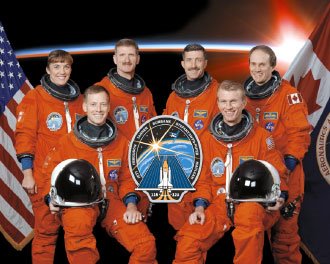
The crew of STS-115 takes a break from training to pose for a group portrait. Astronauts Brent W. Jett, Jr. (right) and Christopher J. Ferguson, commander and pilot, respectively, flank the mission insignia. The mission specialists are, from left to right, astronauts Heidemarie M. Stefanyshyn-Piper, Joseph R. (Joe) Tanner, Daniel C. Burbank, and Steven G. MacLean, who represents the Canadian Space Agency. Credit: NASA
Commander Brent Jett A veteran of three space missions, Jett will lead the crew of STS-115, the shuttle's 19th mission to the space station.+ Read interview + View biography
Pilot Chris Ferguson Ferguson will make his first journey into space as the pilot of the STS-115 shuttle mission.+ Read interview + View biography
Mission Specialist Joe Tanner With five spacewalks to his credit, STS-115 Mission Specialist Tanner will be making his fourth spaceflight.+ Read interview + View biography
Mission Specialist Dan Burbank Assigned as a mission specialist for STS-115, Burbank previously flew on STS-106.+ Read interview + View biography
Mission Specialist Steve MacLean On his second spaceflight, Canadian Space Agency Astronaut MacLean will visit the space station as an STS-115 mission specialist.+ Read interview + View biography
Mission Specialist Heidemarie Stefanyshyn-Piper A member of the 1996 astronaut class, Stefanyshyn-Piper is assigned to STS-115 as a mission specialist.+ Read interview + View biography
Thursday, July 20, 2006
Waterspout spotted, photographed this morning at 10:55 am at KSC

Click picture for the HI-RES version
Monday, July 17, 2006
DISCOVERY LANDS AFTER NEAR FLAWLESS MISSION
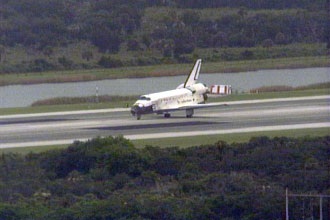
Despite overcast skies, Discovery -- STS-121 -- landed at Kennedy Space Center (KSC) in Florida this morning on its first opportunity, right on schedule, bringing an end to an almost flawless 13-day, 5.3 million-mile mission to the international space station (ISS).
Pilot Mark Kelly fired the shuttle’s engines at 8:07 a.m. local time or Eastern Daylight Time (EDT) to begin the shuttle's descent to Florida. Then, after what appeared to be a fairly textbook re-entry, and following the trademark two sonic booms, Discovery touched down at 9:14 a.m. EDT (6:14 a.m. PDT; 13:14 GMT), rolling to a final stop 1 minute later.
“Welcome back, Discovery,’’ CapCom Stephen Frick said to shuttle commander Steven Lindsey, after the shuttle rolled to a stop. (The CapCom is the ground-based NASA astronaut who is the designated liaison for the astronauts inflight, and is the one who communicates directly to the crew from mission control at Johnson Space Center in Houston.)
“This was a great mission, a really great mission,’’ Lindsey replied. “I enjoyed the entry and landing.’’
This was the second of 2 test flights since the Columbia disintegrated on re-entry in February 2003, and there were, no doubt, many sighs of relief as the shuttle came to a stop on runway 15. Although there had been a few pieces of foam that flew off during launch, and a few technical and equipment glitches, the mission went so well that it was extended by a day. By most all accounts, STS-121 was nearly flawless in achieving all its objectives -- delivering European Space Agency (ESA) astronaut Thomas Reiter, as well as supplies to the station, and preparing for the completion of station assembly.
Both NASA officials and the astronauts expressed confidence and enthusiasm about the shuttle program resuming the task of completing the construction of the ISS, with the next shuttle flight scheduled for December. As Lindsey put it earlier: “I think we’re back to space station assembly, to shuttle flights, but we’re still going to watch, and we’re still going to pay attention. We’re never ever going to let our guard down.”
"It's such a great day I don't think even a press conference can destroy it," said NASA Administrator at the post-landing press conference. "It's as good a mission as we've ever flown, but we're not going to get overconfident . . . and we're not going to get ahead of ourselves." Griffin noted that in addition to completing the ISS, NASA planned to launch a mission to repair the Hubble Space Telescope, although he would not confirm any date for that mission.
In its initial landing approach, Discovery glided at slope of 20 degrees, more than 6 times steeper than the 3-degree slope of a typical commercial jet airliner as it approaches landing. The orbiter touched down on the surface of the Shuttle Landing Facility at KSC at more than 200 miles per hour. The runways at this facility are 15,000 feet long and 300 feet wide, much larger than most commercial runways. For comparison, consider that the longest runway at Los Angeles International Airport (LAX) is 12,091 feet long and 150 feet wide -- 2,909 feet shorter and 150 feet narrower than those at the Shuttle Landing Facility. Although it is used by military and civilian cargo carriers, astronaut T-38 trainers, shuttle training aircraft and helicopters, the facility was specifically designed back in the 1970s for end-of-mission shuttle orbiter landings.
The Expedition 13 crewmembers that Discovery left behind at the ISS -- Commander Pavel Vinogradov, Flight Engineer and NASA Science Officer Jeffrey Williams, and Flight Engineer and Reiter -- watched the shuttle land from on orbit. Reiter's arrival marks the first time the ISS has had a 3-person crew since 2003.
Discovery launched on July 4 into blue skies, the first shuttle ever to launch on Independence Day. Even though 5 pieces of foam had fallen from the external fuel tank -- one of which definitely hit the shuttle -- none of the pieces came off during the early part of the launch and the one that hit the shuttle did not hit any sensitive areas on the spacecraft.
Sunday, July 16, 2006
Saturday, July 15, 2006
Astronauts say goodbyes, begin trip back to Earth
CAPE CANAVERAL, Florida - Space shuttle Discovery decamped from the international space station Saturday to begin a return trip back to Earth. Pilot Mark Kelly fired up steering jets, slowly backed Discovery up and then put it on a path away from the space station as they passed over the Pacific Ocean more than 220 miles (355 kilometers) below.
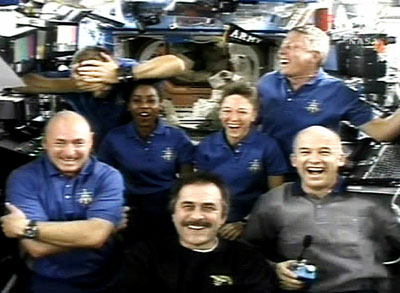
Two hours earlier, Discovery's six astronauts snapped last-minute photos and bid farewell to the space station's crew before closing a hatch for departure. They left behind former crew mate Thomas Reiter of the European Space Agency, who came up in Discovery for a six-month stay at the station with Russian commander Pavel Vinogradov and U.S. flight engineer Jeff Williams. "Have a safe journey back, soft landing and we'll see you on the ground in a few months," Williams radioed Discovery as it backed away. About 45 miles (70 kilometers) from the space station, the Discovery astronauts planned to begin a final inspection of the shuttle's right wing and nose cap - the fourth examination of the shuttle using a robotic arm and boom during the 13-day mission. The shuttle stayed close enough to the space station to dock again if necessary until it was cleared to return to Earth by mission managers reviewing downlinked inspection images. The mission, scheduled to end with a landing Monday at the Kennedy Space Center, has been viewed as a genuine success by NASA managers.
The shuttle launched without any apparent damage to Discovery's thermal protection system - avoiding the problem that doomed Columbia's seven astronauts in 2003. The transfer of supplies and cargo between the shuttle and station was done much faster than expected. Space-walking astronauts repaired a crucial rail car on the space station and were able to show that a 50-foot (15-meter) boom attached to a 50-foot (15-meter) robotic arm could be used as a platform to make repairs to the shuttle.Discovery's crew members set an unofficial record for use of robotics in space, and they delivered Reiter to the space station, raising the number of crew members to three for the first time since the Columbia disaster. There remained only one concern that could affect the astronauts' planned landing at the Kennedy Space Center - a slow leak in one of the shuttle's three units that power hydraulic systems used for steering and braking. It could be leaking harmless nitrogen or flammable hydrazine fuel, but there is no way of knowing that, so NASA is treating the problem as if the leak were fuel.To be on the safe side, NASA will turn on the power unit with the leak early Sunday as part of its normal testing and then see if the leak rate changes. If it does, NASA may burn off the hydrazine and shut down the power unit before the shuttle returns to Earth to eliminate any fire hazard, said John Shannon, the shuttle program's deputy manager. If that happens, the shuttle would land with just its two other power units for the first time in the spacecraft's history. The shuttle needs only one power unit to land.
Tuesday, July 11, 2006
NASA Mulls Duct-Tape Fix for Space Shuttle Problems
Tuesday , July 11, 2006
CAPE CANAVERAL, Fla. — Even in space, a little duct tape may work wonders.
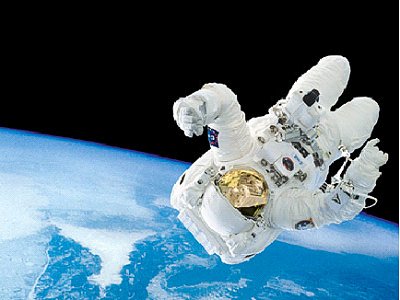
Astronaut Piers Sellers suggested using some of the multipurpose sticky material to fix a safety-jet backpack used during spacewalks after it almost came loose from him while he repaired the international space station.
"Right now, is there some kind of tape fix that you guys could think about that would be helpful?" Sellers asked Mission Control Tuesday morning, a day after the propulsive backpack started to come loose during his spacewalk with astronaut Mike Fossum.
Fossum had to tether the device to Sellers to keep it from flying away.
Click here to visit FOXNews.com's Space Center.
The jet backpack, nicknamed SAFER, is worn by every astronaut during a spacewalk. It allows an astronaut to propel himself or herself to safety in an emergency, for instance if a tether or foot restraint holding the astronaut in place breaks.
The two connecting devices of Sellers' backpack attachment, designed to be used if an astronaut floats free, loosened at different times, but he was never in danger of losing it, NASA officials said.
Sellers and Fossum were to make three spacewalks during space shuttle Discovery's 13-day mission to the space station, which ends next Monday.
During the second spacewalk on Monday, the spacewalkers replaced a cable reel to a rail car needed to move large pieces around the space station and installed a pump compartment for the complex's cooling system.
"That was a great [spacewalk] and it showed that Aggies can be taught to work locks, latches and anything else," flight controllers wrote in their daily morning electronic message to Discovery's crew, referring to Fossum, a graduate of Texas A&M. "Miracles never cease."
Discovery pilot Mark Kelly, who helped choreograph the spacewalk from inside the space station, told Houston he thinks the latches on Sellers' backpack came undone inside the shuttle's crowded payload bay.
"It's surprising that it did happen, but he's bumping a lot around in there," Kelly said Tuesday.
For Wednesday's spacewalk, the astronauts planned to test whether a sealant can be used to repair damaged pieces of the space shuttle's thermal protection system. The technique was developed to make sure there's never a repeat of the Columbia accident that killed seven astronauts in 2003.
The six astronauts of Discovery, along with the three space station crew members, planned to spend most of Tuesday packing up science experiments, trash and unneeded equipment to take back to Earth. They awoke to a recording of Smash Mouth's "All Star" chosen by the family of astronaut Lisa Nowak.
Flight controllers in their electronic message praised the crew for transferring cargo so quickly.
"Transfer is going so well, we thought about giving you a bunch of time off," they said, "but then after the laughter died down, we actually did decide to reduce transfer a few hours today."
Monday, July 10, 2006
Discovery Space Shuttle Cleared by Mission Control for Return Home
HOUSTON — Space shuttle Discovery's astronauts got some happy news Sunday: It's safe to fly home.
Mission Control informed the crew of six that the ship's thermal shielding is "100 percent cleared for entry" in another week.
"Boy, that is great news, that's fantastic," shuttle commander Steve Lindsey said. "And to get all that done by the end of flight day six ... is just amazing."
"Everyone here around the room, as you can imagine, is most happy," Mission Control replied.
Click here to visit FOXNews.com's Space Center.
Only one heat shield issue remained going into the late afternoon mission management meeting — a 2-inch-long (5-centimeter-long) piece of fabric filler sticking out about an inch (2.5 centimeters) from thermal tiles on Discovery's belly. Engineers determined it was not necessary to have an astronaut pluck the strip out during a spacewalk and that it posed no concern for the spaceship's return to Earth on July 17. So managers gave the heat shield an official bill of health.
Officials had already decided that several other nicks and spots — ranging from bird droppings to frayed fabric — were no big deal.
Deputy shuttle program manager John Shannon, chairman of the mission management team, said the healthy shuttle — and the crew's accomplishments in orbit so far — pave the way for the next mission in just over 1 1/2 months. That's when assembly will resume at the international space station; construction was halted by the 2003 Columbia disaster.
Sandwiched between a daring spacewalk Saturday and a crucial but more routine spacewalk Monday, Discovery's crew had an easy day Sunday, said pilot Mark Kelly. They were scheduled to work only 15 hours, instead of 16 hours.
"Today has been a relatively light day compared to the others," Kelly said in the news conference. Those first five days of the mission were so busy "we had to take our meals on the run," Lindsey said.
Saturday's spacewalk, during which astronauts Piers Sellers and Michael Fossum stood on the end of 100 feet (30 meters) of sometimes-oscillating shuttle robotic arm and extension boom, proved that emergency shuttle repair work can be done from that unusual vantage point, the astronauts said. But they said the feeling of being out there at the end of the boom was a little unusual.
"You find yourself lying sideways when you think you're standing up," Sellers said. "It's an unnatural feeling, but not really very unpleasant."
The second spacewalk, which begins at 8:13 a.m. EDT (1213 GMT) Monday, is much like past international space station repair spacewalks. The bulk of the scheduled 6 1/2-hour spacewalk will concentrate on finishing repairs on the station's railcar-like mobile transporter. This is a crucial piece of the station that slides back and forth, helping in the expansion of the outpost.
"We need that thing to be working to move big pieces around during assembly," Sellers said Sunday. "It was dead on one side, kind of limping on just two wheels."
Sellers and Fossum will replace part of the transporter's umbilical reel, which weighs about 330 pounds on the ground. In what may be an awkward maneuver, Sellers will be holding the old umbilical in one hand and the new one in the other, Fossum said.
"The most challenging thing tomorrow is going to be just the choreography, going back and forth in the payload bay," Fossum said. "It's quite a ballet."
NASA planned to post on its Web site Sunday first-of-its-kind video of Discovery's launch as seen from the reusable solid rocket boosters. The video, recovered last week with the boosters, mesmerized engineers in Houston on Saturday.
Wednesday, July 05, 2006
Liftoff!
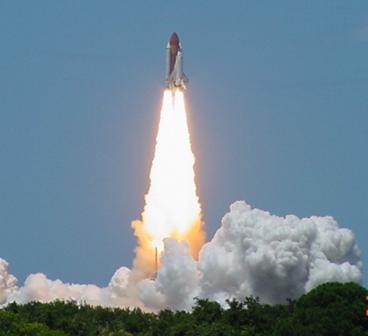
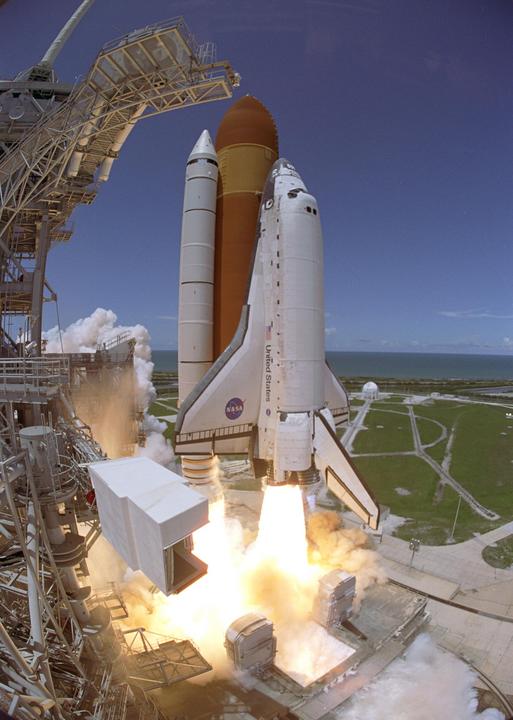
Space shuttle Discovery roared off its Florida launch pad July 4th on a voyage to the International Space Station, a mission whose failure would likely ground the shuttle fleet permanently. Discovery, carrying seven astronauts, lifted off from the seaside launch site at 2:38pm EDT (1838 GMT) and soared into sunny skies, jettisoning its booster rockets about two and a half minutes into the flight.
It reached orbit safely about nine minutes after launch.Postponed twice during the weekend due to bad weather at the Kennedy Space Center, the launch was just the second since the destruction of the shuttle Columbia and the deaths of seven crew members in February 2003.Mission to test fuel tankNASA's top administrators decided to launch Discovery over the objections of some key safety and engineering officials who said the shuttle's troubled fuel tank, which triggered the Columbia disaster, needed additional repairs.Any serious problems with the mission would likely bring a premature end to the US shuttle program and leave the $100 billion space station unfinished. Discovery's mission is to test the fuel tank, carry much-needed equipment and supplies to the space station and make repairs to the orbiting outpost. - Reuters
Monday, July 03, 2006
After two scrubs, Shuttle foam crack puts launch in doubt
CAPE CANAVERAL, Fla. - Inspectors found a 5-inch-long crack in the foam insulation covering the shuttle Discovery's external fuel tank, and NASA managers were deciding Monday whether to call off the scheduled Fourth of July launch. The crack was spotted during an overnight inspection. NASA had scrubbed launch plans Saturday and Sunday because of poor weather and had removed fuel from the tank. The inspectors found the crack, which was 8 inches deep, in the foam on a bracket near the top of the external fuel tank
